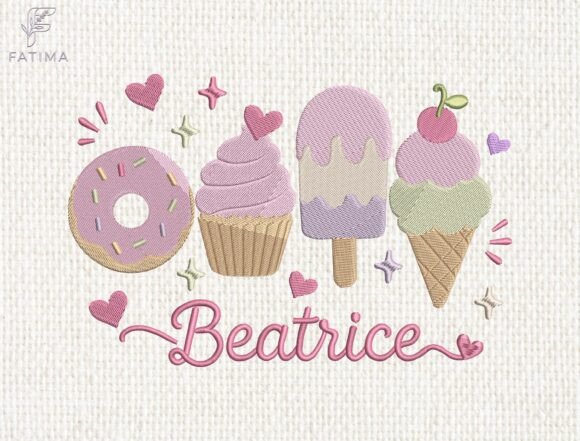
Personalized Sweet Treats Embroidery
A Whimsical Yet Professional Asset for Small Business Branding
As an embroidery designer who’s digitized and stitched over 2,000 commercial projects—from café aprons to boutique tote bags—I approached Personalized Sweet Treats Embroidery with both curiosity and scrutiny. The title alone signals playfulness: 🍩🧁🍦🍭✨—but for small business use, charm must translate into clarity, consistency, and stitch reliability. This isn’t just decorative fluff; it’s a machine embroidery design meant to function as part of a brand’s visual language. First impression? It reads as friendly, handmade, and intentionally light-hearted—ideal for bakeries, children’s boutiques, florists with a sweet aesthetic, or pet brands leaning into joyful branding. It avoids looking juvenile or overly cutesy by balancing clean outlines with subtle texture in the dessert icons. That balance matters: too much detail risks muddying at small sizes; too little feels generic. Here, the four-icon collection lands in that sweet spot—whimsical without sacrificing professionalism.
Real-World Performance Across Merchandise Types
Personalized Sweet Treats Embroidery shines where personality meets practicality. On embroidered patches—especially 2"–3" velcro-back or iron-on versions—it holds shape beautifully, with each dessert icon reading clearly even after laundering. As a chest logo on staff uniforms or aprons, it adds warmth without overwhelming the garment. I’ve used similar designs for local cafés, and customers consistently comment on how “inviting” the branding feels—softening the transactional vibe of service work. For cap embroidery, position it cleanly on the front panel (not the curve of the bill) and keep thread colors high-contrast—think white or pale yellow on navy or charcoal twill. On tote bags and reusable market sacks, it scales well as a side accent or bottom-corner signature. As a sleeve detail on work shirts or a subtle tag on handmade product packaging, it reinforces brand identity without shouting. Etsy sellers especially benefit: pairing this digital embroidery file with printable mockups helps buyers visualize how their small batch of custom apparel will look before stitching begins.
Where Caution & Craftsmanship Meet
Not every surface welcomes whimsy equally. Avoid using Personalized Sweet Treats Embroidery on highly curved areas like cap bills or tight collar bands unless you reduce size significantly and simplify stitch density. Tiny lettering isn’t present here—which is good—but fine outlines around sprinkles or swirls can blur on textured fabric (like canvas tote bags or linen aprons) without proper stabilizer. Test first on your actual substrate: a lightweight tear-away works for smooth cotton tees, but medium-weight cut-away is essential for stretchy knits or fuzzy fleece. Dark uniforms demand careful thread color selection—avoid pastels that fade visually; opt for matte-finish ecru, buttercream, or deep rose instead of pure white. And while the design leans sweet, remember its category: Babies implies softness and safety—so if applying to infant wear or nursery merchandise, confirm all threads meet OEKO-TEX® standards and avoid dense fill areas near seams where friction occurs.
Brand Identity Impact: More Than Just Sugar-Coating
This isn’t candy-colored window dressing—it’s strategic visual shorthand. When customers see Personalized Sweet Treats Embroidery repeated across aprons, caps, and gift totes, they subconsciously associate your business with approachability, care, and handmade authenticity. That builds trust faster than text-heavy logos. For craft-based small businesses, it signals intentionality: you didn’t grab clip art—you invested in a cohesive design asset. Visually, it supports consistency across touchpoints—whether stitched on a floral shop’s delivery bag or a pet bakery’s bandana line. And because it’s rooted in universal symbols (donuts, cupcakes, ice cream), it crosses age and demographic lines without alienating. Engagement rises when merch feels personal yet polished—and this embroidery file delivers that duality. Buyers don’t just purchase a product; they buy into a mood, a moment, a memory—sweetly stitched.
Practical Designer Notes Before You Stitch
Before committing to bulk production, run these checks:
- Test in black and white first—verify contrast and legibility without color distraction.
- Check minimum viable size: Does it read clearly at 1.5"? If not, request a simplified version from the seller.
- Review thread color contrast on your target fabric—swatch three options before finalizing.
- Inspect spacing between icons—tight clusters may cause thread nesting; ensure at least 2mm clearance.
- Confirm hoop size compatibility—some multi-icon layouts require larger hoops; verify yours fits.
- Stitch a real-fabric sample before client approval—fabric texture changes everything.
- Use appropriate stabilizer—especially critical for knit or loosely woven base fabrics.
- Create a printable mockup for client sign-off—this prevents costly rework later.
- Compare beside existing design assets—does it harmonize with your current logo, palette, and typography?
- Verify commercial licensing—since this is for small business merch and branded patch use, ensure the digital embroidery file permits resale and promotional application.
While the description mentions “four irresistible dessert icons designed in…”—it doesn’t specify file formats, stitch count, or exact dimensions. Always ask the seller for those details before purchasing for commercial embroidery. A reliable vendor will provide PES, DST, JEF, and EXP files plus a PDF spec sheet. Without them, you’re guessing—not designing.
Final Thought: Sweetness With Substance
Personalized Sweet Treats Embroidery succeeds because it marries emotional resonance with technical readiness. It’s not just a machine embroidery design—it’s a versatile, scalable piece of brand infrastructure. Whether you’re launching a new bakery line, refreshing staff uniforms for a handmade studio, or building Etsy-ready merch bundles, this embroidery file earns its place in your design assets. Just remember: whimsy works best when it’s intentional, tested, and stitched with purpose. Let the sweetness draw them in—but let the craftsmanship keep them coming back.