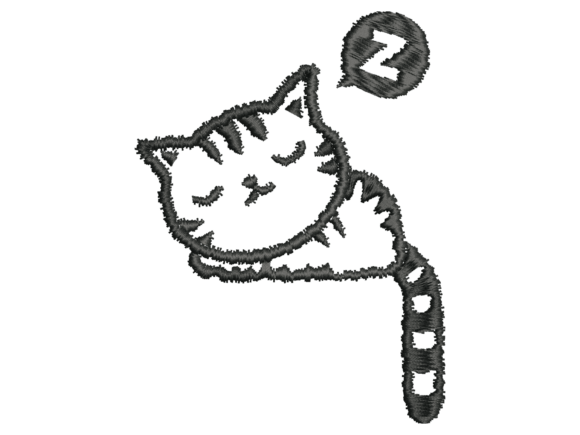
Sleeping Cute Cat Embroidery
First Impressions: Soft, Sweet, and Surprisingly Versatile
When I opened the Sleeping Cute Cat Embroidery file for the first time, I wasn’t just scanning for stitch count or hoop compatibility—I was asking: *Does this feel like something people will want to hold, wear, or give?* It does. The pose is relaxed but intentional—paws tucked, ears softly folded, whiskers barely sketched in satin stitch. There’s no forced cuteness; it reads as gentle, quiet, and handmade in the best way. That matters when you’re stitching for a boutique baby blanket or embroidering a linen tea towel for a local gift shop. This isn’t a cartoon—it’s a whisper of feline calm, which makes it unusually adaptable across product types.
A Real Project Test: Custom Tote Bags for a Local Bookstore
Last week, I used Sleeping Cute Cat Embroidery on a set of organic cotton tote bags for a neighborhood indie bookstore launching a “Cat & Chapters” summer series. We placed the design centered on the front panel, sized at 3.2 inches tall—just right for visibility without overwhelming the fabric’s drape. On light beige canvas, the satin-stitched fur details held beautifully, and the subtle fill stitch in the ear gave dimension without density. Customers responded immediately—not with “Oh, it’s cute,” but with “I *need* that bag.” That’s the difference between decoration and connection. The design didn’t shout; it invited touch, conversation, and repeat visits.
Where It Shines (and Where It Asks for Extra Care)
Sleeping Cute Cat Embroidery excels in projects where softness and sentiment carry the message:
- Personalized gifts: Baby onesies, nursery pillows, and holiday stockings—especially when paired with gentle thread colors like heather gray, oatmeal, or dusty rose.
- Small business merchandise: Aprons for bakeries, tea towels for cafés, and embroidered patches for craft fair vendors who value cohesive, low-key branding.
- Commercial embroidery: Sweatshirt embroidery for pet-friendly apparel lines or custom caps for cat rescue fundraisers—provided the hoop size allows clean placement above the curve.
But—and this is where experience kicks in—Sleeping Cute Cat Embroidery asks for thoughtful execution on textured or unstable fabrics. On terry cloth towels, I added tear-away + cut-away stabilizer combo to prevent puckering around the chin curve. On stretchy jersey for a toddler sweatshirt, I skipped the satin stitch outline and ran a tight running stitch perimeter instead—keeping the shape crisp without snagging. And on dark fabric? I tested thread contrast first: a medium charcoal gray thread read clearly against navy, but pale lavender vanished. Always test.
What It Adds to Your Finished Product—Beyond the Stitch
This isn’t just about how it looks stitched—it’s about what it *does* for your work. A well-executed Sleeping Cute Cat Embroidery elevates perceived value instantly. Handmade product buyers notice subtlety: the slight taper of the tail, the negative space around the paws, the balanced stitch density that avoids stiffness. That builds trust—especially for Etsy sellers listing personalized gifts. When a customer sees that kind of intention, they assume care went into every step: sourcing, hooping, trimming, packaging. It also strengthens brand consistency for small shop owners using embroidery as part of a larger visual language—think muted palettes, minimalist layouts, quiet storytelling.
Design Notes You’ll Want Before You Hoop Up
As someone who’s stitched hundreds of digital embroidery files, here’s what I’d tell myself before loading Sleeping Cute Cat Embroidery:
- Always test on scrap fabric first—especially if using it on curved surfaces like caps or layered garments like reversible pillow covers.
- Check thread color contrast in natural light *and* under store lighting. What reads softly on screen may disappear on dark denim or thick fleece.
- Review stitch density in your embroidery software. If fill areas look overly dense, consider reducing density by 5–8% for lightweight cotton or baby knits.
- Confirm hoop size—the layout is compact, but those delicate ear tips need breathing room. Don’t force it into a 3x3 hoop unless the file explicitly supports it.
- Inspect small details at 200% zoom: are whiskers defined enough? Does the nose satin stitch land cleanly? Tiny gaps become visible on finished products.
- Test in black and white mockups—this design relies on shape and rhythm more than bold contrast, so grayscale previews reveal clarity issues fast.
- Use proper stabilizer—lightweight cut-away for knits, medium-weight tear-away for stable wovens, and fused + tear-away for nap-heavy fabrics like velour or fleece.
- Verify licensing before selling finished items or bundling the digital embroidery file with other design assets. Since this is a digital embroidery file delivered in ZIP or RAR format with no physical item shipped, commercial use terms depend entirely on the creator’s license—check before scaling.
Final Thought: Not Just Another Cat Design
There are dozens of cat embroidery files out there. What sets Sleeping Cute Cat Embroidery apart is its restraint. It doesn’t try to be playful, fierce, or funny—it simply *is*. That makes it endlessly repositionable: tender for baby items, nostalgic for vintage-style kitchen towels, quietly confident for boutique apparel. For craft business owners, Etsy sellers, and creative entrepreneurs building a recognizable handmade aesthetic, it’s not filler—it’s foundation. Use it thoughtfully, test it honestly, and let its calm presence do the work. Because sometimes, the most memorable embroidery isn’t the loudest—it’s the one that feels like it belongs.