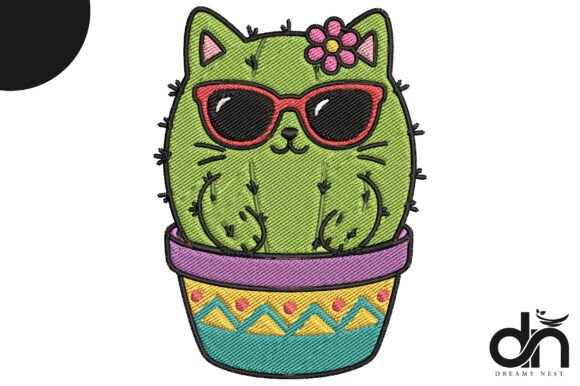
Cool Cat Cactus Embroidery Design
First Impression: Funny, Fresh, and Instantly Memorable
As an embroidery designer who’s prepped over 200 craft fair booths, I can tell you this at a glance: Cool Cat Cactus Embroidery Design lands with playful confidence. It’s not farmhouse, not minimalist, and definitely not fussy—it’s bold humor wrapped in clean botanical charm. The emoji cues (🌵🕶️✨) aren’t just flair; they telegraph tone before a single stitch is laid down. Customers walking past your booth will pause—not because it’s loud, but because it’s *unexpectedly clever*. That’s gold for handmade product appeal, especially in the Nursery category where whimsy meets intention.
Where It Shines on Craft Fair Products
This design thrives where personality meets practicality. On a tote bag design, it reads perfectly centered near the bottom hem—big enough to catch eyes from three feet away, small enough to leave room for branding or a tagline. As apron embroidery, it works beautifully above the pocket: compact, conversational, and instantly relatable for plant-loving parents and kitchen creatives alike.
Tea towel embroidery is where Cool Cat Cactus Embroidery Design becomes a quiet star. Stitched in soft cotton thread on natural linen or unbleached canvas, it adds warmth without clutter—ideal for boutique makers curating cohesive, giftable handmade product lines. As an embroidered patch, it’s highly portable, easy to iron-on or sew, and perfect for customizing denim jackets, backpacks, or baby bibs—all top-sellers at weekend markets.
For caps and curved surfaces? Proceed with care—but it *can* work. A simplified version (no tiny cactus spines or micro-sunglasses detail) holds up well on structured front panels. And on pillow covers or small fabric pouches? Absolutely ideal. Its balanced proportions scale down gracefully, making it a strong small shop product for Etsy sellers bundling nursery-themed gift sets.
Real-World Production Notes Every Embroiderer Should Know
This isn’t a “set-and-forget” machine embroidery design. As a working designer, I always ask: Does it translate across fabrics, sizes, and stitching conditions? Here’s what I’ve observed:
- Stitch density matters. If the cactus arms or sunglass frames are tightly stitched, they may pucker on lightweight knits or textured tea towels—test with tear-away + light cut-away stabilizer.
- Thread colors make or break the vibe. Neon green + charcoal gray reads “cool.” Olive + cream reads “earthy nursery.” Always test contrast on your base fabric—especially dark fabric, where fine details vanish without proper underlay.
- Hoop size and spacing are non-negotiable. Before batch production, confirm the largest version fits comfortably in your most-used hoop with at least ¼" margin. Crowded spacing between elements risks skipped stitches on high-speed machines.
- Tiny details need scrutiny. That little smirk? The sunglass reflection? They’re charming—but if rendered below 1.5" wide, they blur into abstraction. Use it as a focal point, not a border motif.
Photography, Listings, and Online Conversion
This design photographs exceptionally well—for both in-person booth samples and digital listings. Its high-contrast shapes and clear silhouette pop in natural light, making it a standout in printable mockups for Etsy sellers. Unlike overly intricate motifs, Cool Cat Cactus Embroidery Design retains legibility even in thumbnail previews. That’s critical when shoppers scroll past dozens of nursery-themed embroidery files.
It also supports strong brand consistency. Whether you’re selling embroidered burp cloths or market bags, this design anchors your line with wit and cohesion—no need to explain the concept. Buyers get it instantly. That kind of clarity shortens decision time, especially among time-crunched craft fair shoppers or Etsy buyers comparing digital embroidery files.
Booth Impact & Buyer Engagement
In my last spring fair, I displayed six items featuring Cool Cat Cactus Embroidery Design: a denim tote, linen apron, organic cotton tea towel, reversible pouch, snapback cap, and mini pillow cover. The apron and tea towel drew the most comments—and the most sales. Why? Because they’re functional, giftable, and visually uncomplicated. People didn’t just say “cute”—they said “I need that for my plant lady friend” or “My toddler would love this cat.” That emotional hook is rare and valuable.
It also strengthens your display rhythm. Place it beside softer botanicals or neutral monograms, and it becomes a joyful accent—not competition. In a crowded aisle, that contrast creates visual breathing room and draws attention without shouting.
Designer Checklist Before You Stitch or Sell
Before cutting fabric or uploading to your shop, run through these essentials:
- Test the embroidery file on scrap fabric matching your intended product—especially for texture and weight.
- Confirm thread contrast works on both light and dark fabric variants.
- Review spacing and alignment in your embroidery software—don’t assume centering is automatic.
- Check recommended hoop size and verify it aligns with your machine’s capabilities.
- Inspect stitch density in dense zones—adjust underlay or reduce density if needed for soft fabrics.
- Use appropriate stabilizer: light cut-away for knits, tear-away for stable wovens, and fusible + tear-away for towels.
- Create at least one real-world finished product mockup—not just a digital render—to assess drape, scale, and wearability.
- Compare how the design reads across multiple fabric colors—what looks sharp on ivory may read muddy on oatmeal.
- Verify commercial embroidery rights. If licensing isn’t explicitly stated in the product description, contact the creator before selling physical goods.
Final Thought: A Smart Addition to Your Design Assets
Cool Cat Cactus Embroidery Design isn’t just another cute motif—it’s a versatile, mood-lifting, conversation-starting asset. It bridges nursery sensibility with modern wit, scales reliably across product types, and delivers strong ROI for both craft fair tables and online shops. For Etsy sellers, small-batch makers, and embroidery business owners building recognizable style, it’s a low-risk, high-reward addition to your design assets. Just remember: great embroidery starts with smart prep—not just pretty pixels. Stitch intentionally, test thoroughly, and let that cool cat do the rest.