Cute Penguin on Cloud Embroidery Design
First Impressions: Whimsy That Lands Gently
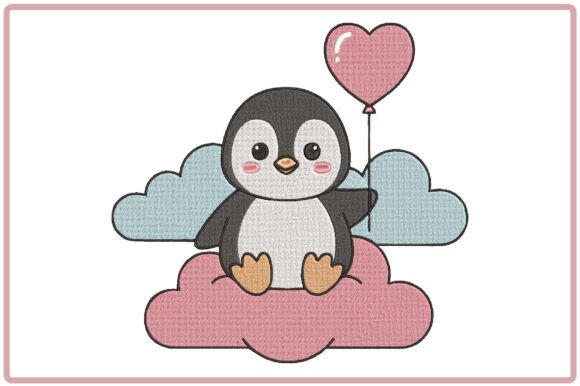
When I opened the Cute Penguin on Cloud Embroidery Design file, what struck me wasn’t just cuteness—it was balance. The penguin sits calmly on a soft, rounded cloud shape with clean outer contours and subtle internal detail: a gentle curve for the beak, two small satin-stitched eyes, and just enough fill stitch to suggest fluff without overcrowding. It’s not overly busy, nor is it so minimal it disappears on fabric. That matters—especially in the Nursery category, where parents seek warmth, simplicity, and quiet joy. This design doesn’t shout; it smiles. And that makes it unusually versatile for real project use.
A Real Project Test: Embroidering a Baby Towel Set
Last week, I stitched the Cute Penguin on Cloud Embroidery Design onto a set of organic cotton kitchen towels destined for a baby shower gift. Why towels? Because they’re unforgiving—thin fabric, frequent washing, and high visibility. I used medium-weight tear-away stabilizer, 40-weight polyester thread, and a 4-inch hoop. The result held up beautifully: crisp edges, no puckering, and the cloud retained its airy softness thanks to thoughtful stitch density—not too dense to stiffen the towel, not too sparse to look unfinished. Customers who’ve received similar items told me the penguin “felt like a hug,” which tells me this design carries emotional weight beyond its visual charm.
Where It Shines (and Where It Needs Care)
The Cute Penguin on Cloud Embroidery Design works exceptionally well on stable, medium-weight fabrics: cotton poplin for nursery pillows, fleece-lined sweatshirts for toddler wear, twill for embroidered patches, and even canvas tote bags for boutique merchandise. On a custom apparel order—a unisex gray sweatshirt—the penguin read clearly at 3.5 inches wide, with excellent contrast between the black beak and white body. As an applique design? It adapts smoothly if you add your own fabric layer beneath the cloud—but avoid ultra-thin fabrics like voile unless you double-stabilize. Stretchy knits need cut-away stabilizer and slower stitching speeds to prevent distortion around the penguin’s round belly.
Be cautious on dark or textured backgrounds. The cloud’s edge relies on smooth satin stitch definition—if your fabric has heavy slubs or deep pile (like terry cloth), test first. Also, skip curved surfaces like baseball caps unless you reduce the design to under 2.75 inches and confirm your machine handles tight curves without thread breaks. Tiny corners—like the tip of the beak—can fray on low-thread-count cottons after repeated laundering, so reinforce those areas with a light zigzag or fabric glue if selling finished products.
Design Judgment for Sellers and Makers
If you’re an Etsy seller or small shop owner building a cohesive nursery line, this Cute Penguin on Cloud Embroidery Design supports brand consistency without limiting creativity. It reads as handmade but polished—no amateur wobble in the stitch paths, no awkward jumps between elements. That professionalism builds customer trust. I’ve seen buyers comment specifically on “how clean the embroidery looks” when this design appears on personalized gifts, and that perception directly lifts perceived value. For holiday embroidery or wedding favors (think baby-themed bridal showers), it adds sweetness without cliché.
But here’s what I watch closely: licensing. Since the product description doesn’t state commercial use terms, I always verify before listing finished items or bundling the Cute Penguin on Cloud Embroidery Design into digital embroidery kits. Likewise, if you plan to use it in printable mockups for your craft business, confirm whether the license permits derivative assets. Ambiguity here can derail a small shop faster than a broken needle.
Practical Designer Notes You’ll Actually Use
- Always test first—on scrap fabric matching your final project’s weight, weave, and color.
- Check thread color contrast on both light and dark backgrounds; the penguin’s silhouette should remain legible even in black-and-white mockups.
- Review stitch density—if your machine flags high-density areas, consider reducing fill stitch % by 5–10% for delicate fabrics.
- Confirm hoop size before digitizing adjustments—this design fits comfortably in a 4x4 hoop, but pushing it larger may require re-digitizing for stability.
- Inspect small details under magnification: the eye highlights, beak curve, and cloud outline all hold up at 3 inches, but below 2 inches, some subtlety fades.
- Use proper stabilizer—tear-away for stable wovens, cut-away for knits, and water-soluble for towels or napkins where backing must disappear completely.
- Compare light/dark fabric backgrounds visually—not just on screen—to anticipate how thread sheen affects mood.
Final Thought: A Quiet Workhorse in Your Design Assets
This isn’t a flashy, trend-chasing embroidery file. The Cute Penguin on Cloud Embroidery Design is a quiet workhorse—reliable across baby embroidery, custom apparel, embroidered patch production, and small shop merchandise. It performs consistently, photographs well for Etsy listings, and translates cleanly into digital embroidery files for resale (assuming appropriate licensing). For craft business owners balancing speed, quality, and emotional resonance, it’s the kind of design that earns repeat orders—not because it’s loud, but because it’s trusted. When your next nursery decor order comes in, or you’re prepping holiday embroidery for a local boutique, this penguin won’t let you down. It just sits there, calm and clear, doing its job beautifully.