Summer Beach Hand Embroidery Pattern PDF
A Practical Review for Small Business Merchandise & Branded Patches
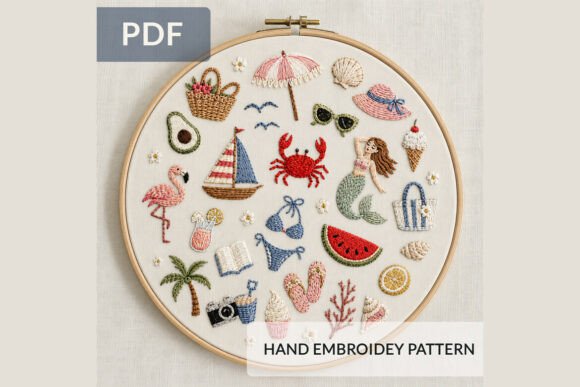
As an embroidery designer who’s developed hundreds of commercial patterns for cafés, boutiques, florists, pet brands, and handmade studios, I approach every new Hand Embroidery Patterns release with two questions: “Does it translate to real-world business use?” and “Will it strengthen—rather than dilute—my client’s brand identity?” When I first saw the Summer Beach Hand Embroidery Pattern PDF, the title and description—“Coastal Vacation Hoop Embroidery Design DIY 🏖️🦩 Escape to a sunny seaside paradise…”—immediately signaled a warm, approachable, and distinctly summery visual tone. It reads as playful, handmade, and inviting—not overly polished or corporate, but intentionally charming. That’s a strong starting point for small businesses that want authenticity over austerity.
How It Performs Across Real Business Applications
The Summer Beach Hand Embroidery Pattern PDF shines where personality matters most: embroidered patches, apron embroidery, tote bag design, cap embroidery, and boutique merchandise. Its whimsical coastal elements—think stylized flamingos, gentle waves, sun motifs—carry clear seasonal appeal without feeling dated or overly literal. For a local bakery launching summer specials, this pattern could become a limited-run sleeve detail on staff shirts. A florist might scale it down for a subtle chest logo on linen aprons. A pet brand could adapt the flamingo motif into a playful collar tag patch—keeping the line work clean and recognizable even at 1.5 inches tall.
Because it’s designed as a hoop embroidery design, the layout inherently respects negative space and stitch-friendly flow—key for both hand and machine embroidery workflows. As a digital embroidery file, it lends itself well to conversion into vector-based appliqué or screen-print-ready artwork for multi-channel branding. When used on tote bags or reusable market sacks, the design adds tactile charm while reinforcing a relaxed, community-oriented vibe—ideal for farmers’ markets, beachside shops, or eco-conscious brands.
Where to Use It Thoughtfully (and Where to Adapt)
Like any Graphics-based embroidery asset, the Summer Beach Hand Embroidery Pattern PDF demands context-aware application. On curved surfaces—like cap fronts or rounded product tags—the outermost elements (e.g., palm fronds or sun rays) may need slight simplification to avoid distortion. Tiny lettering isn’t mentioned in the description, so if custom text is added later, confirm spacing and legibility at 0.3" height before finalizing.
Stitch density is another practical consideration. Whimsical designs often include layered textures—think feathered flamingo outlines or wavy water lines—that can increase thread build-up. For high-wash items like staff uniforms or aprons, test the finished product after three laundering cycles to assess wear resistance. Dark fabrics also require attention: verify contrast using neutral or bright thread colors (e.g., coral, seafoam, butter yellow) rather than relying solely on default palettes. And always pair it with appropriate stabilizer—especially on lightweight cottons or textured linens—to prevent puckering around delicate curves.
Brand Identity Impact: More Than Just Cute
Small businesses don’t just buy embroidery—they invest in perception. The Summer Beach Hand Embroidery Pattern PDF supports brand trust by signaling craftsmanship and intentionality. Unlike generic clip art, its hand-drawn rhythm conveys care—a subtle cue that resonates with customers seeking authentic handmade products. Used consistently across aprons, tote bags, and packaging accents, it builds visual consistency without rigid repetition. A café might feature the full pattern on a welcome banner, then isolate the flamingo icon as a stitched tag on pastry boxes—creating recognition through variation, not duplication.
For Etsy sellers and craft-based brands, this pattern strengthens buyer engagement: it feels personal, seasonal, and shareable. Customers photograph embroidered totes at the beach; staff wear caps with quiet confidence. That organic visibility is worth more than any ad spend—and it starts with choosing a design that balances aesthetic joy with technical reliability.
Essential Embroidery Designer Notes Before Production
Before committing to bulk runs or client delivery, run these checks:
- Test in black and white first—to assess value contrast and silhouette strength, especially for patches and cap fronts.
- Verify small-patch viability—scale the design down to 1.75" wide and check if key features (e.g., beak shape, wave curve) remain distinct.
- Review thread color contrast against your fabric swatches—not just on screen. Coastal tones pop on navy, but fade on heather grey unless adjusted.
- Inspect spacing between elements: tight clusters risk thread tangling during machine embroidery; open areas ensure breathability on summer apparel.
- Confirm hoop size compatibility—if stitching in-house, match the design’s natural bounding box to your standard hoops (e.g., 4"x4" or 5"x7").
- Test on real fabric, not just tear-away stabilizer alone—especially for textured weaves or stretchy blends.
- Create a printable mockup for client approval, showing front/back placement options on common garment types.
- Compare beside existing design assets—does it harmonize with your logo, typography, and other branded embroidery files?
- Confirm commercial licensing before using on resale items. Since this is labeled a DIY pattern, double-check usage rights for small business merch and embroidered patch production.
Remember: the Summer Beach Hand Embroidery Pattern PDF isn’t just decoration—it’s a functional piece of your brand’s visual language. Whether applied to a barista’s apron or a boutique’s gift tag, it carries your values, seasonality, and attention to detail. Choose wisely, test thoroughly, and let the seaside charm do what it does best—invite, delight, and connect.